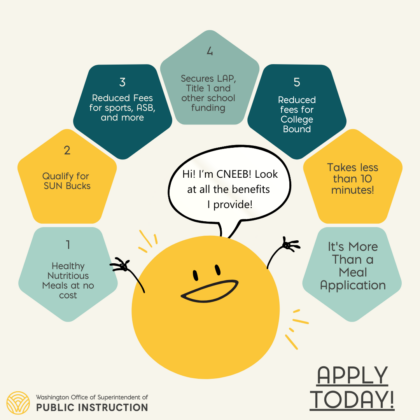
 Some families ask, “If my student’s school already offers free meals to everyone, why should I fill out the form?” PTAs can answer: the CNEEB unlocks more than just meals.
The CNEEB Application merges the free and reduced-price meal application and the Family Income Survey. Through submission of the CNEEB Application, in addition to free meals, households may qualify for summer EBT benefits (if enrolled in an NSLP/SBP school), reduced fees for other programs and activities, and/or help secure other educational funding for the Local Education Agency.
PTAs can help our membership understand the importance of filling out this form by highlighting the need. Forms can be found at https://ospi.k12.wa.us/policy-funding/child-nutrition/school-meals/washington-school-meals-application-finder
Free and Reduced Lunch and Title I – How do they intersect?
The Title I Education Program is the oldest and largest federal education program, authorized under the Elementary and Secondary Education Act (ESEA). It supplements state and local funds to help schools serving low-income students meet academic standards, especially in high-poverty communities. In Washington state, Title I, Part A (“Closing Educational Achievement Gaps”) supports over 350,000 students annually through targeted assistance or schoolwide programs, with requirements for evidence-based instruction, parent engagement, and qualified staff. One third of Washington state public schools operate as Title I schools.
Why should schools and families emphasize filling out the CNEEB forms?
- Secure Funding: Many federal and state grants are tied to the number of students enrolled in free or reduced-price meal programs. Accurate data ensures schools receive adequate funding for everything from classroom supplies to extracurricular activities.
- Identify Gaps: If certain groups aren’t participating in the program despite being eligible, schools can investigate why. Are language barriers preventing families from applying? Is there stigma around accepting assistance?
- Tailor Support Services: Schools often use this data to allocate resources like tutoring, counseling, or after-school programs to students who need them most.
- Advocate for Change: On a broader scale, aggregated demographic data helps lawmakers understand trends in child poverty, food insecurity, and educational equity.
Take Action
Local and council PTAs are often the closest voice to families. Consider getting this message into your newsletters, social media, and back-to-school communications: encourage every household to complete the CNEEB Application — even at schools that already offer universal free meals. Each completed form helps secure funding, close gaps, and strengthen support for students across Washington. Share the application finder with your families today: https://ospi.k12.wa.us/policy-funding/child-nutrition/school-meals/washington-school-meals-application-finder